Brand consistency is often treated as a design issue. In reality, it is an organizational one.
Most large organizations are not short on ideas or activity. The challenge is alignment. Different teams move at different paces, make decisions independently and respond to their own priorities. Over time, the brand starts to feel less defined. Messages shift. Visuals vary. The brand experience depends on where and how someone interacts with the organization.
Our client, Viterbo University, had a strong identity rooted in its mission and values, but lacked a clearly defined brand platform or a shared messaging structure to guide communication across teams.
Where Inconsistency Shows Up
Inconsistency usually builds gradually. One campaign takes a slightly different tone. Multiple departments create separate messaging. A website section evolves without connection to the larger structure. Each decision makes sense on its own but together create a fragmented experience.
At Viterbo, this showed up across departments. Admissions, academics and athletics were all telling valid stories, but they were not connected. There was no shared framework to define what messages should lead, how they should be supported or how the university should sound across channels.
When brand and experience are not aligned, audiences have to work harder to understand what the organization stands for. That slows decision-making and weakens trust.
Why It Happens
Most organizations have pieces of a brand. Fewer have a system that connects them.
A few patterns tend to drive the problem:
- Decentralized teams
- Departments operate independently. Without a shared structure, variation increases.
- Speed of content
- Teams are producing more content than ever, often without time to align on strategy.
- Multiple audiences
- When universities speak to prospective students, families, donors, alumni and the community without a clear framework, messaging starts to diverge.
- Disconnect between strategy and execution
- Even when leadership is aligned, that clarity does not always translate into day-to-day work. These are normal conditions in complex organizations.
What Consistency Requires
Consistency is not about making everything look or sound the same. It is about making sure everything connects. At Viterbo, that required building a system from the ground up.
Shared Understanding
The work started with research. Surveys, stakeholder interviews and working sessions across the university helped define what Viterbo stands for and how it is experienced.
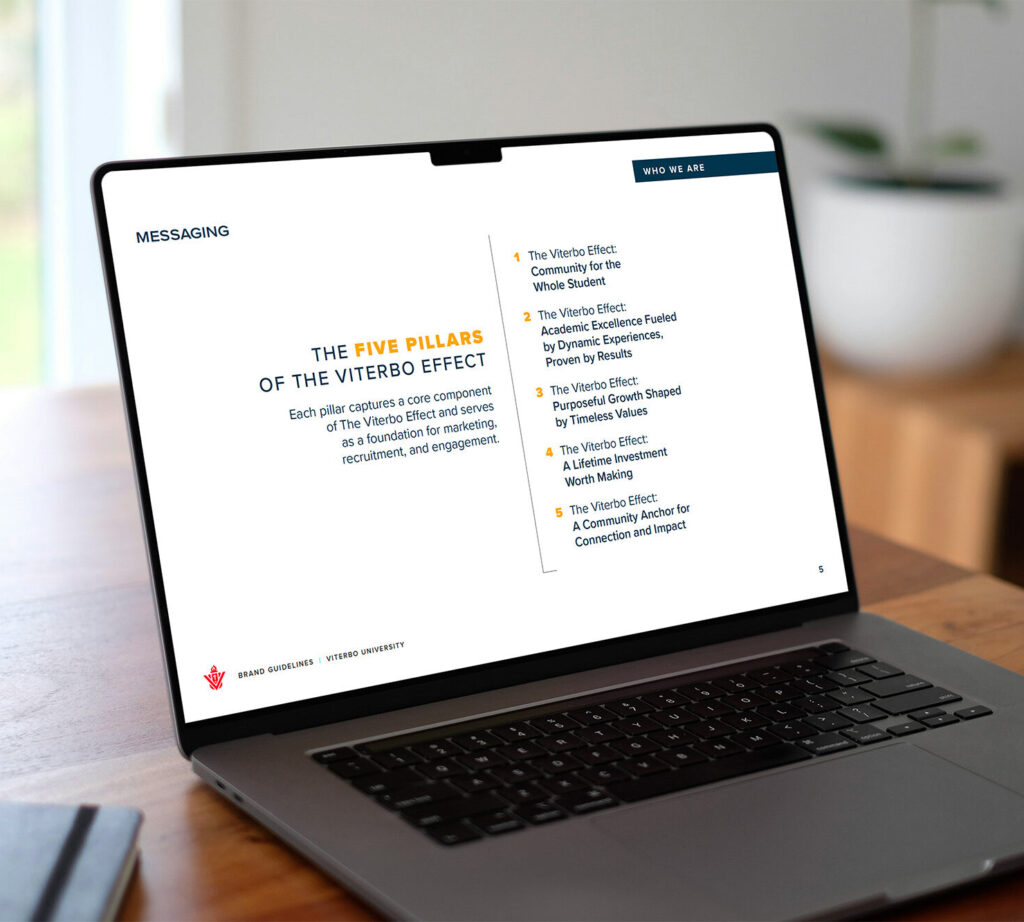
From that, a clear brand platform was developed, anchored in a central idea: “The Viterbo Effect.” This became the core message that connects the university’s mission, values and student experience.
The platform also introduced five messaging pillars that define how the story is told across audiences, from community and belonging to academic outcomes and long-term impact.
Clear messaging structure
With the platform in place, messaging became structured and repeatable.
Teams now had clarity on:
- What messages to lead with.
- How to support those messages with proof.
- How to adapt content for different audiences without losing alignment.
This replaced a model where each department built messaging independently.
A visual identity that reflects the brand
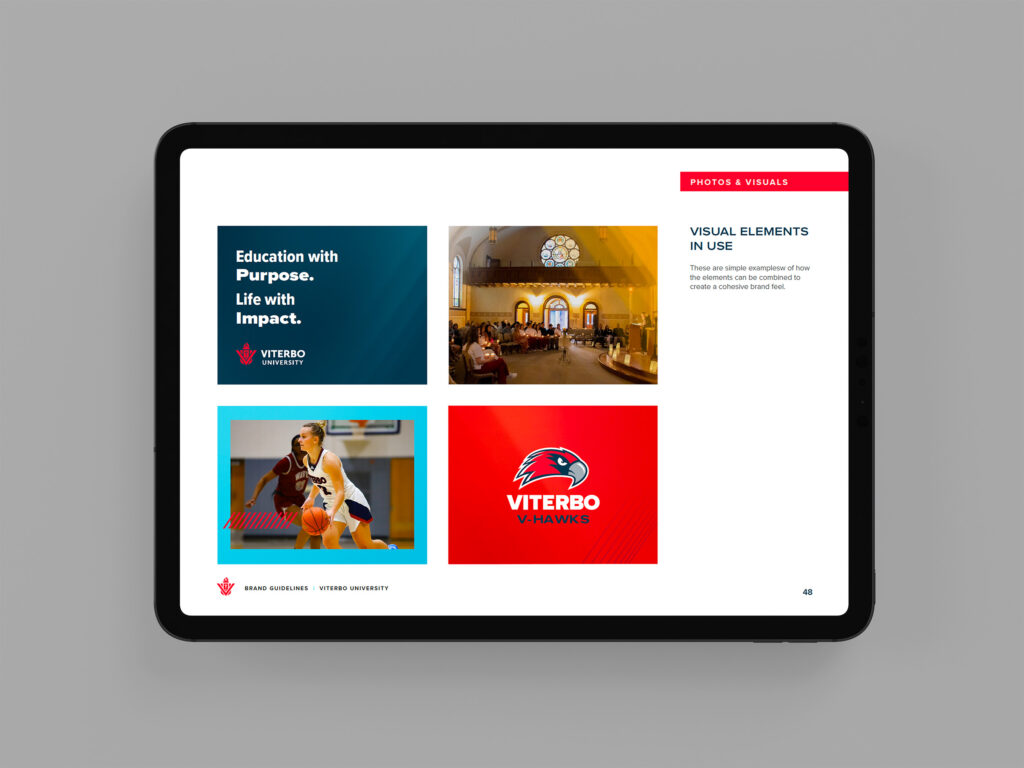
The visual identity was refreshed to better align with the brand platform.
This included updates to color, typography and overall system rules to create a more cohesive and recognizable presence across materials. The goal was not just consistency, but alignment between how Viterbo looks and what it stands for.
Tools that make consistency easier
Strategy and design only work if teams can apply them.
To support campus-wide adoption, a set of practical tools was developed:
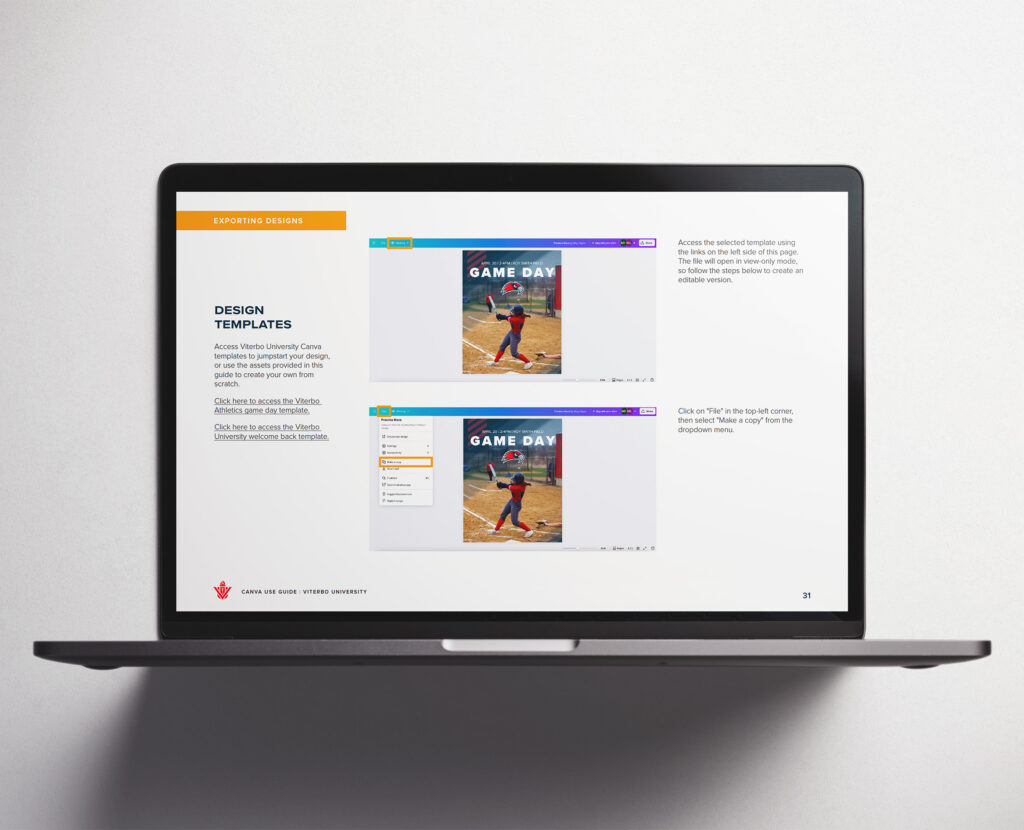
- A comprehensive brand guide covering messaging, visuals and usage.
- An athletics-specific brand guide to translate the platform for that division.
- Canva brand kits and templates to standardize everyday materials.
- Clear rules for logos, sub-brands and asset usage across departments.
How We Approach The Work
At Neuger, branding starts with how an organization operates, not just how it looks. At Viterbo, that meant working across leadership, marketing, admissions and athletics to define a shared foundation and carry it through to execution.
The process included:
- Research through surveys, interviews and stakeholder sessions.
- Development of the brand platform and messaging system.
- Visual identity refinement to align with the strategy.
- Creation of brand guides and division-specific extensions.
- Development of tools and templates to support daily use.
What It Leads To
When brand consistency is in place, the experience changes.
At Viterbo, teams now work from a shared structure. Messaging connects across departments. Materials are easier to create and easier to align. The brand reflects a consistent understanding of what Viterbo stands for and what students can expect.
Consistency doesn’t limit flexibility. It creates a structure that allows organizations to adapt without losing clarity.
Ready to align your organization’s brand?
Book a call with us today to learn more about our branding services.